International Journal of Clinical Pediatrics, ISSN 1927-1255 print, 1927-1263 online, Open Access
Article copyright, the authors; Journal compilation copyright, Int J Clin Pediatr and Elmer Press Inc
Journal website https://ijcp.elmerpub.com

Review

Volume 000, Number 000, May 2026, pages 000-000


Associated Arthropathies in Pediatric Endocrine Disorders: A Systematic Review and Narrative Synthesis

Figures

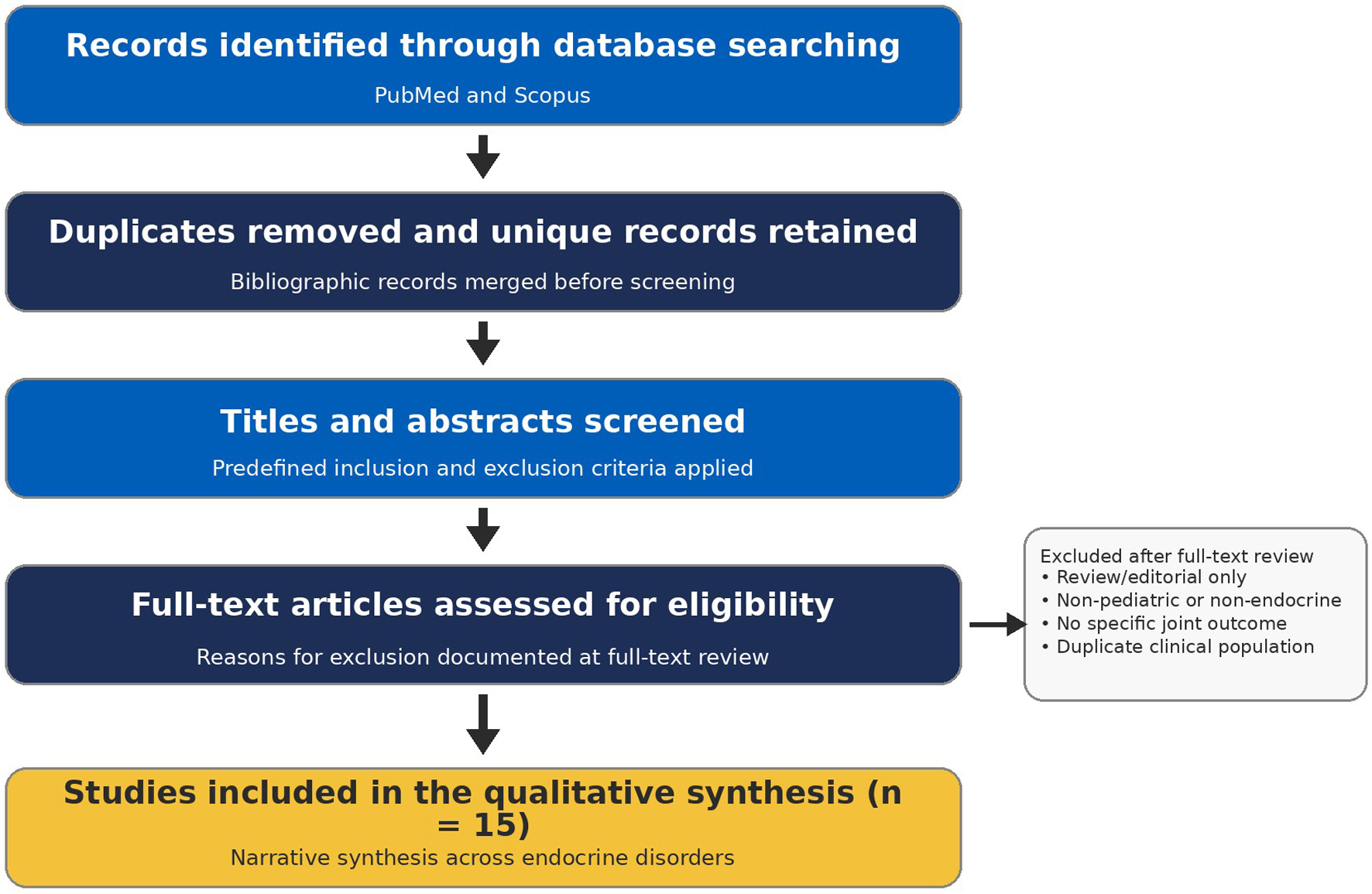
↓  Figure 1. PRISMA-style study-selection pathway for the systematic review. This PRISMA-style figure summarizes database searching, duplicate removal, screening, full-text eligibility assessment, and final inclusion of 15 studies in the qualitative synthesis.
Figure 1.
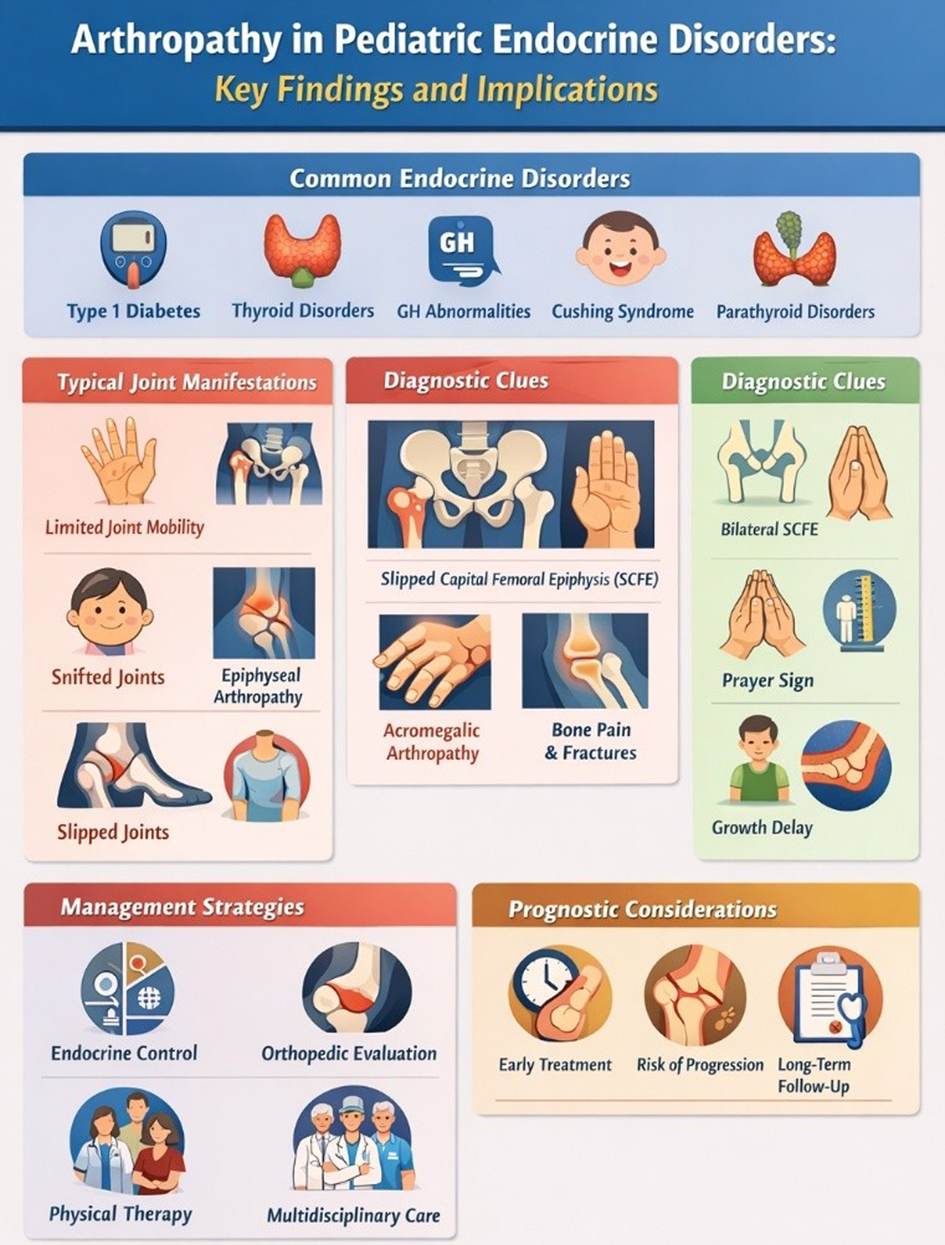
↓  Figure 2. Arthropathy in pediatric endocrine disorders: clinical patterns, diagnostic clues, and management pathways. Infographic summarizing disorder-specific joint manifestations, diagnostic red flags, and management considerations in pediatric endocrine arthropathy. SCFE: slipped capital femoral epiphysis.
Figure 2.

Tables

↓  Table 1. Study Characteristics and Key Clinical Messages of Arthropathy in Pediatric Endocrine Disorders
 
Study (first author, year)Study typePopulation (endocrine disorder)Key findings related to arthropathy
GH: growth hormone; LJM: limited joint mobility; SCFE: slipped capital femoral epiphysis; UK: United Kingdom; USA: United States of America.
Rosenbloom, 2013 [9]Historical cohort analysis (1970s vs. 1990s)476 children with type 1 diabetes (USA)Prevalence of limited joint mobility (LJM) declined from ∼30% to ∼7% over two decades; LJM associated with poor metabolic control and ∼4-fold increased risk of microvascular complications.
Clarke, 1990 [11]Cross-sectional70 children with type 1 diabetes (UK)LJM prevalence 31% by prayer sign; 7% using strict criteria. More frequent with older age and longer diabetes duration; no significant HbA1c correlation in this small cohort.
Montana, 1995 [12]Cross-sectional89 adolescents with type 1 diabetes (Spain)LJM present in ∼42%; moderate–severe in 14%. Strong association with microalbuminuria, suggesting linkage with early diabetic microangiopathy.
Arkkila, 2003 [13]Narrative review (pediatric data included)Children and adults with diabetes mellitusSummarized musculoskeletal complications of diabetes, including LJM and cheiroarthropathy; highlighted higher prevalence with longer disease duration and poor glycemic control.
McLean, 1995 [4]Literature review and case seriesPediatric and adult hypothyroid patientsHypothyroidism is associated with arthralgia, non-inflammatory joint effusions, and in children, epiphyseal dysgenesis and SCFE; synovial fluid typically viscous and acellular.
Gutch, 2013 [14]Prospective cohort (6-month follow-up)29 children with juvenile hypothyroidism (India)Delayed bone age and metaphyseal thickening in all patients; short stature improved with therapy, but epiphyseal abnormalities persisted in >50% after 6 months; one SCFE case identified.
Lehmann 2006 [15]Retrospective cohort85 children with SCFE and endocrine disorders (USA)Endocrine-related SCFE frequently bilateral and atypical; hypothyroidism and GH deficiency most common associations; recommended routine endocrine screening in atypical SCFE.
Karthikeyan, 2012 [16]Case report8-year-old girl with pseudohypoparathyroidism type 1b (UK)Bilateral SCFE as presenting feature; associated with physeal widening and genu valgum; orthopedic fixation plus calcitriol led to physeal healing over 2 years.
Lindgren, 2023 [17]Review with case series90 patients with acromegaly (mostly adults; adolescents included, but pediatric subgroup not separately reported)Highlighted endocrine etiologies (hypothyroidism, GH deficiency, hyperparathyroidism); endocrine-related SCFE occurred outside typical age/weight range and was frequently bilateral.
Dons, 1988 [18]Retrospective cohort (long-term follow-up)31 patients with long-term controlled acromegaly (mixed-age cohort; pediatric subgroup not separately reported)Universal radiographic osteoarthritis at baseline; continued progression of hand and spine arthropathy despite biochemical remission in >80%; findings derive from a mixed-age cohort rather than a pediatric-only series.
Pelsma, 2021 [19]Prospective cohort (9-year follow-up)1 adolescent with Graves disease (Brazil)Universal radiographic osteoarthritis at baseline; continued progression of hand and spine arthropathy despite biochemical remission in >80%.
Perini, 2019 [20]Case report16-year-old boy with Graves disease (Brazil)Thyroid acropachy developed 2 years after radioiodine therapy; periosteal new bone formation and digital clubbing; rare pediatric manifestation.
Benina, 2023 [21]Case seriesThree children with primary hyperparathyroidism (Korea)Presentations included bone pain, gait disturbance, and fractures; all due to parathyroid adenoma; musculoskeletal symptoms improved after surgery.
Lodish, 2018 [22]Retrospective cohortChildren with endogenous Cushing syndrome (USA)Vertebral fractures and musculoskeletal pain are common at diagnosis; bone density improved after cure, but some skeletal morbidity persisted.


↓  Table 2. Disorder-Specific Clinical Manifestations and Reported Prevalence of Arthropathy in Pediatric Endocrine Disorders
 
Endocrine disorderType of arthropathy/musculoskeletal involvementReported prevalence in children/adolescentsKey references (serial order)
GH: growth hormone; GHD: growth hormone deficiency; SCFE: slipped capital femoral epiphysis.
Type 1 diabetes mellitusLimited joint mobility (cheiroarthropathy), predominantly hands; may extend to wrists and elbows7–42% (historical cohorts up to 30–42%; contemporary cohorts ∼5–10%)[11–13]
Juvenile hypothyroidismArthralgia, non-inflammatory joint effusions, epiphyseal dysgenesis; SCFE (rare but characteristic)Arthralgia/effusions 10–30%; SCFE < 5% (largely case-based)[4, 14, 16]
Hyperthyroidism (Graves disease)Arthralgia, periosteal reaction; thyroid acropachy (very rare)Arthralgia < 10%; acropachy < 1%[20, 23]
Growth hormone excess (gigantism/acromegaly)Degenerative arthropathy involving hands, spine, knees, and hips70–80% in mixed-age cohorts including adolescents; pediatric-only prevalence unavailable[18, 19]
Growth hormone deficiencyNo primary inflammatory arthritis; increased risk of atypical SCFE and reduced bone strengthSCFE in GHD < 5% (overrepresented in atypical SCFE series)[17]
Cushing syndrome (endogenous)Bone pain, vertebral fractures, reduced mobilityVertebral fractures 20–35%; musculoskeletal pain > 50%[22, 24]
Primary hyperparathyroidismBone pain, gait disturbance, fractures; chondrocalcinosis (rare)40–60% in small pediatric series[21]
PseudohypoparathyroidismSkeletal dysplasia, occasional SCFE, functional joint limitationArthropathy uncommon; SCFE sporadic (case-based)[16]


↓  Table 3. Prevalence and Features of Diabetic Arthropathy (Limited Joint Mobility) in Children With Type 1 Diabetes
 
StudyYearNo. of diabetic patients (age)Prevalence of LJMNotable associations
HbA1c: glycated hemoglobin; LJM: limited joint mobility.
Rosenbloom et al [9] (historical cohort/era comparison)1976–1998182 (7–18 years) in 1976–1978; 294 in 1998∼30% (1970s) → ∼7% (1998)LJM associated with about four-fold increased long-term risk of microvascular complications; higher cumulative glycemic exposure markedly increased LJM risk.
Clarke et al [11] (cross-sectional)199070 (8–17 years)31% (prayer sign); 7% (strict criteria)Higher prevalence with older age and longer diabetes duration; ∼12% of controls showed mild limitation, highlighting the need for standardized assessment.
Rosenbloom et al [5, 6, 9] (prospective natural history)1981, 1982, 2013309 (children and young adults, 1–28 years)∼30% overallLJM clustered in early-onset and pubertal-onset diabetes; associated with reduced linear growth in early cohorts; many cases asymptomatic on routine care.
Traisman et al [25] (screening study including siblings/controls)1978310 children with diabetes plus siblings/controls8.4% (contractures)Contractures also observed in siblings and controls, suggesting background susceptibility and reinforcing the importance of uniform diagnostic thresholds.
Campbell et al [26] (cross-sectional)1985Young patients with type 1 diabetesVariable (criteria-dependent)LJM associated with microvascular complications, supporting its role as a marker of cumulative metabolic burden rather than isolated joint disease.


↓  Table 4. Thyroid-Related Arthropathy and Musculoskeletal Manifestations in Children and Adolescents
 
StudyYearPopulation (age)Thyroid disorderArthropathy/musculoskeletal phenotypeReported prevalenceNotable associations/clinical implications
SCFE: slipped capital femoral epiphysis.
McLean & Podell [4]1995Pediatric and adult cases (narrative review)HypothyroidismNon-inflammatory arthralgia, high-viscosity joint effusions, epiphyseal dysgenesis; hip involvement more prominent in childrenNot pooledPediatric hypothyroidism may present with joint limitation and physeal disease rather than classic adult patterns; emphasizes endocrine testing in unexplained effusions.
Gutch et al [14]201329 children (juvenile onset)HypothyroidismDelayed bone age, metaphyseal thickening, epiphyseal abnormalities; occasional SCFEJoint-specific prevalence not quantifiedGrowth improves with levothyroxine, but skeletal abnormalities may persist early after treatment, highlighting the importance of early diagnosis.
Moyer et al [27]20162 children + literature reviewHypothyroidismAtypical slipped capital femoral epiphysisRare (case-based)Recommends thyroid screening in SCFE presenting outside the typical age or weight range or with delayed healing.
Ploegstra et al [23]201115-year-old girlGraves disease (on antithyroid drugs)Antithyroid drug–induced arthritisVery rareRapid resolution after drug withdrawal; important to distinguish from primary inflammatory arthritis.
Nihei et al [28]20132 children (11 and 15 y)Graves diseaseAcute polyarthritis during methimazole therapyVery rareSupports early cessation of thionamides when severe arthritis develops.
Pereira et al [20]201916-year-old boyGraves diseaseThyroid acropachy (periosteal reaction, digital clubbing)< 1%Prolonged untreated hypothyroidism can cause severe locomotor disability, largely reversible with thyroid hormone replacement.
Tullu et al [29]20032 children (7 y; 15 months)Long-standing hypothyroidismKocher–Debré–Semelaigne syndrome with functional musculoskeletal limitationRareProlonged untreated hypothyroidism can cause severe locomotor disability, largely reversible with thyroid hormone.


↓  Table 5. Growth Hormone (GH) Excess– and Deficiency–Related Arthropathy in Children and Adolescents: Key Clinical Patterns and Representative Evidence
 
StudyYearStudy typePopulation (GH disorder)Arthropathy/musculoskeletal phenotypeKey findings relevant to arthropathy
GH: growth hormone; GHD: growth hormone deficiency; IGF-1: insulin-like growth factor-1; OA: osteoarthritis; SCFE: slipped capital femoral epiphysis.
Rostomyan et al [31]2015Multicenter cohortPituitary gigantism (pediatric-onset GH excess)Arthralgia and early degenerative joint changes accompanying rapid linear growth and soft-tissue overgrowthLarge international cohort describing the clinical burden of pediatric-onset GH excess; musculoskeletal complaints, including joint pain, are frequent and often prompt evaluation alongside accelerated growth.
Beckers et al [32]2018Evidence synthesis/reviewPituitary gigantism (pediatric-onset GH excess)Overgrowth-related joint pain; propensity to early osteoarthropathy in longstanding GH excessDemonstrated that prolonged GH/IGF-1 excess drives cartilage and periarticular tissue hypertrophy, predisposing to early degenerative arthropathy and supporting proactive musculoskeletal assessment.
Claessen et al [33]2017Comparative MRI studyActive vs. controlled acromegaly (mixed-age cohort; disease biology relevant to adolescent-onset GH excess)“Acromegalic arthropathy” with knee cartilage thickening, osteophytosis, and OA-like changesShowed high prevalence of structural joint abnormalities; some cartilage features improved with biochemical control, whereas structural damage often persisted, informing mechanisms relevant to pediatric-onset disease.
Colao et al [34]2017Narrative review with clinical synthesisAcromegaly (mixed-age clinical synthesis)Progressive degenerative arthropathy affecting hands, spine, hips, and kneesHighlighted that GH excess–related arthropathy may progress despite biochemical remission, supporting the concept of partially irreversible joint disease once established.
Blethen et al [35]1996Registry safety analysis16,514 children receiving recombinant GH (NCGS)Slipped capital femoral epiphysis (SCFE) as GH therapy–associated hip arthropathyIdentified SCFE as a rare but clinically important orthopedic complication during GH therapy, emphasizing the need for vigilance for hip or knee symptoms in growing children.
Darendeliler et al [36]2007Nationwide population-based cohort80,769 children with endocrinopathy and 191,004 without endocrinopathySCFE as an endocrinopathy-associated growth-plate complicationSCFE incidence was approximately fourfold higher in children with endocrinopathy than in children without endocrinopathy (37.1 vs. 9.0 per 100,000). Among endocrinopathies, growth hormone deficiency had the highest SCFE incidence (583.8 per 100,000), supporting risk stratification and early hip evaluation.
Hwang et al [30]2024Children with endocrinopathy: 80,769Endocrinopathy-associated SCFE: 30/191 (16%)SCFE incidence was ∼4× higher in children with endocrinopathy vs without: 37.1 vs. 9.0 per 100,000Among endocrinopathies, growth hormone deficiency (GHD) had the highest SCFE incidence: 583.8 per 100,000


↓  Table 6. Overall Risk of Bias Across Studies Included in the Review
 
Overall risk of biasReference numbersMain study types representedBrief quality summary
SCFE: slipped capital femoral epiphysis.
Low risk5–7, 19, 22, 24, 30, 31, 33, 35, 36Large cohorts, population-based studies, prospective longitudinal studies, registry analyses, comparative imaging studiesStrong population definition, clear outcome ascertainment, and consistent exposure assessment. Longitudinal follow-up and population-based designs reduce selection bias; residual confounding possible but generally well controlled.
Moderate risk8, 11, 12, 14, 15, 17, 18, 21Retrospective and prospective cohorts, cross-sectional studies, imaging studies, medium-sized clinical seriesNon-randomized designs with variable outcome definitions (e.g., LJM criteria, arthropathy phenotypes, SCFE ascertainment) and incomplete adjustment for confounders such as disease duration or severity. Generally robust clinical populations with biologically plausible and clinically anchored outcomes.
High risk1–4, 9, 10, 13, 16, 20, 23, 25–29, 32, 34Narrative reviews, expert syntheses, case reports/series, very small uncontrolled cohortsHigh susceptibility to selection and reporting bias; limited generalizability; often descriptive without standardized outcome measurement. Particularly valuable for rare phenotypes (e.g., thyroid acropachy, antithyroid drug–induced arthritis, pseudohypoparathyroidism-related SCFE, Kocher–Debré–Semelaigne syndrome) but not suitable for prevalence estimation.